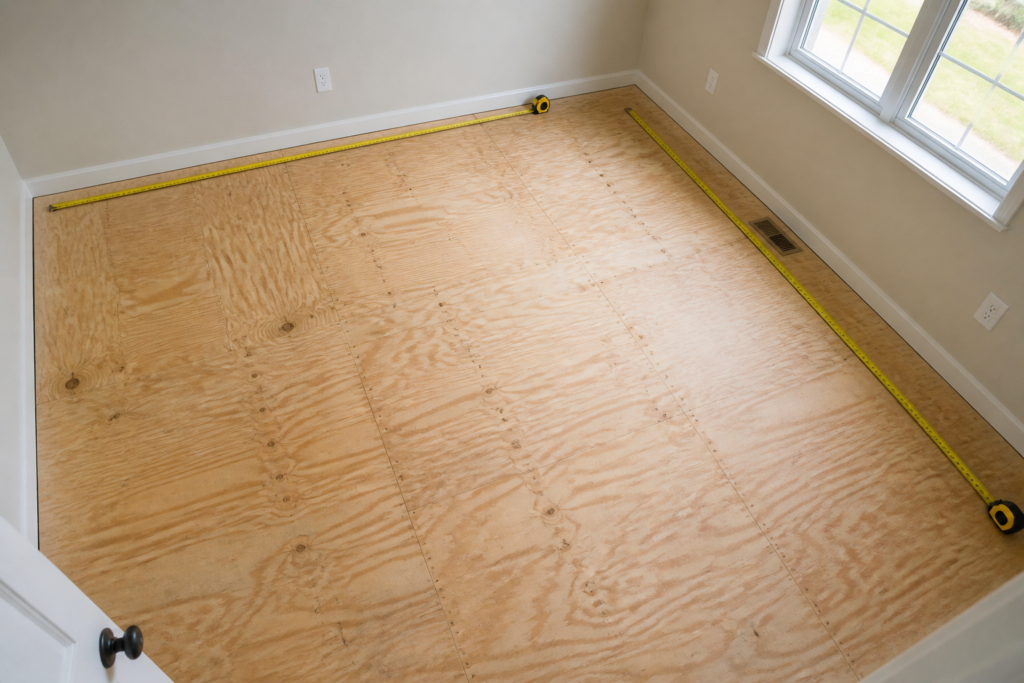
Home improvement means upgrading or repairing a house’s structure, surfaces, and fixtures. The easiest high-impact upgrades are fresh paint, new hardware, better lighting, and trim, in that order.
The easiest home improvement upgrades are the ones that change the most visible surface per dollar. In a 12×14 bedroom, paint covers 100% of the 540 sq ft of wall and ceiling surface, while a door swap changes 3.7%. Fixing drywall first, then painting, delivers the largest visible result for the money.
Key Takeaways
- Paint changes 100% of a room’s 540 sq ft surface. A door swap changes 3.7%.
- A flat 10% waste rule gives 19 drywall sheets on net area and 21 on gross area.
- Door and window cutouts cause 44 of the 68 sq ft of waste in the sample room.
- Work order: repair drywall, install doors and trim, prime, paint, and then add hardware and lighting.
What Is Home Improvement?
Home improvement is any repair, upgrade, or renovation that raises a house’s function, comfort, condition, or appearance.
Home Improvement MintPalDecor: Ranking Easy Upgrades by Impact
In a 12×14 bedroom with 540 sq ft of net wall and ceiling surface, six upgrades rank as follows.
| Rank | Upgrade | Visible impact (12×14 room) | Relative cost |
| 1 | Wall and ceiling paint | 540 sq ft (100%) | Low |
| 2 | Cabinet and door hardware | Under 1% of surface | Low |
| 3 | Light fixtures and bulbs | Changes light across all 540 sq ft | Low to medium |
| 4 | Baseboard and trim | About 21 sq ft (4.0%) | Medium |
| 5 | Door replacement | 20 sq ft per door (3.7%) | Medium to high |
| Prerequisites | Drywall repair | Hidden once painted | Low |
How Are Home Upgrades Ranked by Impact?
Each upgrade is ranked by the share of a room’s visible surface it changes, weighed against relative cost and skill level. Paint wins because it changes all 540 sq ft. The ranking is an editorial scoring method, not a homeowner survey.
Which Easy Upgrade Delivers the Most for the Least Money?
Interior paint delivers the most visible change per dollar because it transforms every wall and ceiling surface, and a first-time painter can finish a 12×14 bedroom in a weekend. Hardware and lighting follow because each costs little and changes how the room reads. Doors and trim rank lower because each changes under 5% of the visible surface.
Lighting and Hardware: Small Swaps, Fast Results
Matching metal finishes across knobs, pulls, and fixtures makes a room read as planned. Comparing finish samples on inspiration pages such as myinteriorpalace keeps handles, hinges, and light fixtures consistent.
Bulb color temperature matters as much as the fixture. Design tips mintpaldecor upgrades rely on matching one warm-white temperature, 2700K to 3000K, across every fixture in a bedroom.
Doors and Trim: Lower Coverage, Higher Visibility
A door swap changes 20 sq ft, or 3.7% of the sample room’s surface. Baseboard changes about 21 sq ft (4.0%) across 49 linear feet.
Replacing interior doors pays off because doors sit at eye level in every hallway. Basic interior design logic treats doors, trim, and hardware as one framing system, so their finishes should match.
How Many Drywall Sheets Does a 12×14 Bedroom Need?
The sample room:
- Size: 12 ft x 14 ft with an 8-ft ceiling
- Openings: one 3 x 6.67 ft door (20 sq ft) and two 3 x 4 ft windows (24 sq ft)
- Gross surface: 416 sq ft of walls plus 168 sq ft of ceiling, or 584 sq ft
- Net surface after openings: 540 sq ft
- Standard 4×8 sheet: 32 sq ft
What Is the Flat 10% Drywall Waste Rule?
The flat 10% rule adds one-tenth to the measured drywall area, then divides by 32 square feet per 4×8 sheet and rounds up to whole sheets. A drywall calculator applies the same steps, but the sheet count depends on whether the starting number is gross or net area. In this room, the gross area gives 21 sheets, and the net area gives 19.
How Does a Sheet-by-Sheet Layout Compare With the Flat Rule?
A sheet-by-sheet layout of the sample room needs 19 sheets of 4×8, or 12 sheets of 4×12 plus one 4×8, and both buy 608 square feet. Long sheets remove joints because each 12-foot wall course takes a single board.
| Method | Sheets | Board bought | Overage vs. 540 sq ft net |
| Flat 10% on gross area (584 sq ft) | 21 (4×8) | 672 sq ft | 132 sq ft (24%) |
| Flat 10% on net area (540 sq ft) | 19 (4×8) | 608 sq ft | 68 sq ft (12.6%) |
| Layout with 4×8 sheets | 19 | 608 sq ft | 68 sq ft (12.6%) |
| Layout with 4×12 sheets plus one 4×8 | 13 | 608 sq ft | 68 sq ft (12.6%) |
Where Does Drywall Waste Actually Come From?
Door and window cutouts cause 44 of the 68 square feet of waste in the sample room, so openings, not trimming, drive most drywall overage. That is 65% of the total, and the other 24 sq ft is offcuts from the ceiling and wall strips. The flat rule allows 54 sq ft on net area, so measured waste runs 14 sq ft above the allowance.
When the Drywall Math Changes
The 4×12 layout fails when long boards cannot clear stair turns or narrow hallways. Delivery access then decides the sheet size, and the 19-sheet 4×8 count applies. Soffits, vaulted ceilings, and angled walls push the average above 12.6%.
Installers disagree on cutouts. Some reuse window-header pieces to patch closets, and others scrap them. Full reuse is uncommon because each window cutout is only 12 sq ft.
The 10% and 12.6% figures measure different things. The 10% figure is an ordering allowance applied to net area. The 12.6% figure is the calculated overage for this one room after rounding to whole boards. The 21-sheet and 19-sheet counts differ only in the starting area, gross or net.
Panel layout, joint placement, and finishing follow the Gypsum Association’s GA-216 application standard, and local codes override any calculation.
Why Low-Cost Upgrades Fit a Cooling Market
Homeowners are projected to spend about $519 billion on improvements and repairs through mid-2027, but growth is cooling. The Harvard Joint Center for Housing Studies’ July 23, 2026 Leading Indicator of Remodeling Activity puts year-over-year growth at just 0.5% in the second quarter of 2027.
Those are two different numbers. The $519 billion is total annual spending, and the 0.5% is how fast that total is growing. When growth stalls, cost per visible result matters most, which is why the ranking above starts with the cheap upgrades.
The Right Upgrade Order: Repair, Prime, Paint, Finish
The order of the work matters as much as what gets bought. The tips mintpaldecor projects to follow are simple: repair first, primer next, and finish coats last.
- Patch and sand any drywall damage. A drywall patching walkthrough helps with anything wider than a nail hole.
- Hang new doors and install trim before paint goes on the walls. A door style comparison makes matching trim profiles easier.
- Prime the patches and the new trim, or the repairs will show through the finish.
- Paint the ceiling, then the walls, then the trim. A paint color selection guide narrows the choices.
- Add hardware, light fixtures, and bulbs at the end.
Standard decoration advice says to finish surfaces before adding accessories. The same logic keeps paint dripping off new hardware.
Settle the color plan before buying paint. Reference photos on sites such as Homezel make sheen and undertone easier to pick, and they head off repaints.
FAQs: Home Improvement Questions
What Is the Easiest Home Improvement Upgrade?
Painting walls and ceilings is the easiest high-impact upgrade. It takes basic tools, changes 100% of a room’s visible surface, and costs little. Patch any drywall damage first, or the repairs will show through the finish coat. Two coats over primer give even coverage.
How Many Sheets of Drywall Does a 12×14 Bedroom Need?
A 12×14 bedroom with an 8-foot ceiling needs 19 sheets of 4×8 drywall once one door and two windows are subtracted from the walls and ceiling. Start from the gross area, and the count jumps to 21. Switch to 4×12 boards, and it drops to 13: twelve 4×12 sheets and one 4×8.
Is 10% Enough Drywall Waste?
Ten percent is enough when it’s applied to net area after the openings are subtracted. It’s too low for rooms with lots of corners, soffits, or vaulted ceilings. In the sample room, 10% of the net area was bought exactly for the 608 sq ft of the layout needed. Odd shapes mean more cuts and offcuts, so the allowance goes up.
Should Paint or New Doors Come First?
Doors and trim go in before paint. Hanging new casing after the walls are painted means caulking, touching up, and repainting the same surfaces all over again. The ranking table sorts upgrades by value per dollar, while this sequence sorts the work. Anyone who’s only painting can skip the step.
What Size Drywall Sheet Is Best for a Bedroom?
Sheets of 4×12 suit a 12×14 bedroom best, since one board spans a 12-foot wall course. The catch is that 4×8 sheets are far easier to carry up stairs. A 4×12 sheet is heavy and takes two people, or a lift, to get onto a ceiling. Access at the house usually settles the choice.
Conclusion: The Short Answer
Home improvement MintPalDecor priorities come down to order and coverage. Repair the drywall and paint first for the biggest visible change, then move on to hardware, lighting, trim, and doors. In a 12×14 room, 19 sheets cover the job, and openings account for 65% of the waste.