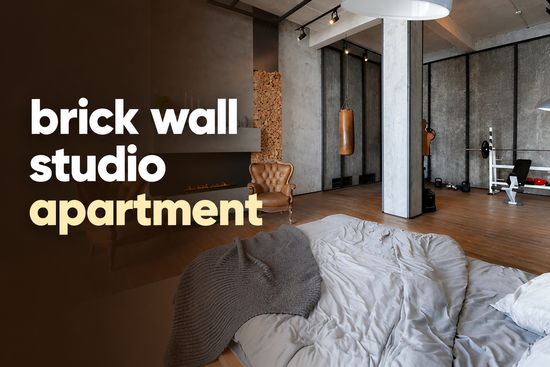
A brick wall studio apartment is a one-room home with one wall of exposed, thin-veneer, or faux brick. The brick adds texture and warmth while using almost no floor space.
The best approach for most US studios is brick on a single wall, usually the longest uninterrupted one. The original brick needs cleaning and a breathable sealer. Where no brick exists, thin brick veneer weighs about 5 pounds per square foot, so a 108-square-foot wall adds roughly 540 pounds instead of 4,300.
Renters and owners comparing finishes can pair these numbers with the small-space room guides in the designmode24 interior design library.
Key takeaways
- One brick wall is enough. In a room under 500 square feet, brick on two or more walls absorbs light and makes the space read smaller.
- A 12 ft by 9 ft studio wall (108 sq ft) needs about 741 modular thin bricks, or 815 with a 10% waste allowance.
- Thin brick adds about 540 pounds to that wall. Full-depth brick adds about 4,320 pounds and needs structural support.
- Full-depth brick takes about 4.6 square feet of floor along a 12-foot wall. Thin brick takes under 1 square foot.
- Renters get the look with removable panels or wallpaper. Mortared brick is a permanent alteration that needs the landlord’s written consent.
What is a brick wall studio apartment?
Definition: A brick wall studio apartment is a single-room dwelling in which one wall is finished in real or imitation brick as the room’s main design feature.
The look comes from converted factories and prewar buildings in cities such as New York, Chicago, and Boston, where an exposed brick wall is part of the original structure. Newer buildings copy it with veneer or panels. US studios are small: Trulia’s June 2026 listing data puts the average studio at 485 square feet, so every inch of wall depth matters.
Which type of brick wall suits a studio?
Thin brick veneer suits most owned studios, faux brick wall panels suit most rentals, and original brick only needs cleaning and a breathable sealer to finish it. The right choice depends on who owns the wall and how much weight the structure carries. Weights below are approximate and vary by manufacturer.
| Option | Thickness | Weight (lb per sq ft) | Load on a 108 sq ft wall | Renter-friendly |
| Original brick, cleaned and sealed | Existing wall | None added | 0 lb | Yes |
| Thin brick veneer | 1/2 to 1 in | About 5 | About 540 lb | No, permanent |
| Full-depth brick veneer | 3-5/8 in | About 40 | About 4,320 lb | No, needs structural support |
| Polyurethane faux panels | 3/4 to 1 in | Under 1 | Under 108 lb | Sometimes, leaves screw holes |
| Peel-and-stick brick wallpaper | Under 1/16 in | Negligible | Negligible | Yes |
How many bricks does a studio wall need?
How is the brick count calculated?
A 108-square-foot studio wall needs about 741 modular thin bricks, or 815 with a 10% waste allowance, based on 6.86 bricks per square foot. The count comes from the brick face plus one mortar joint, not from the brick alone. Skipping the joint overstates the order by about 22%.
- Measure the wall: 12 ft wide by 9 ft high equals 108 sq ft.
- Subtract openings. A 3 ft by 5 ft window removes 15 sq ft, leaving 93 sq ft.
- Find the module. A modular thin brick face is 2 1/4 in. by 7 5/8 in. Add a 3/8 in joint to each dimension: 2-5/8 in by 8 in, or 21 sq in.
- Divide 144 sq in by 21 sq in: 6.86 bricks per sq ft.
- Multiply: 108 sq ft needs 741 bricks. The 93 sq ft wall with a window needs 638.
- Add 10% for cuts and breakage: 815 bricks, or 702 with the window.
A tile calculator runs the same area-and-waste arithmetic for any face size, and home resources such as Homezel are a useful second check on quantities before ordering. Modular dimensions follow the thin brick sizes described in the Brick Industry Association’s Technical Note 28C.
How much weight and floor space does the wall take?
Thin brick adds about 540 pounds and under 1 square foot of floor loss, while full-depth brick adds about 4,320 pounds and takes 4.6 square feet. Full-depth brick is 3-5/8 in deep and needs a 1 in air space, so a 12 ft wall loses a strip 4-5/8 in deep. The thin brick with its setting bed is about 3/4 in deep.
That lost floor has a rental price. Trulia’s June 2026 listings show an average studio asking rent of $1,516 for 485 square feet, or $3.13 per square foot per month. At that rate:
- Full-depth brick: 4.6 sq ft costs about $14.40 a month, or $173 a year, in floor the tenant pays for and cannot use.
- Thin brick: 0.75 sq ft costs about $2.35 a month, or $28 a year.
Two studio-size figures circulate and measure different things. Trulia’s 485 square feet is the average of active listings in June 2026. HireAHelper’s 2026 apartment size report gives 440 square feet from a separate dataset. The rent-per-foot figure above uses Trulia’s rent and size together, so the two inputs match.
How to design a studio around a brick wall
Where should the furniture go?
Place the bed or sofa against the brick wall so the texture frames the main furniture, and keep tall storage on the opposite wall to balance visual weight. A brick accent wall works as a headboard and artwork in one, which frees budget and wall space elsewhere. Most studio apartment ideas fail by blocking the brick with wardrobes or shelving.
- Float low furniture, under 36 in high, in front of the brick.
- Mount shelves into mortar joints, not brick faces, so holes are easy to patch.
- In a small apartment layout, use a rug and a low bookcase to mark the sleeping zone instead of a partition.
How much lighting does brick need?
Red brick reflects roughly 10% to 20% of light, against 80% or more for white paint, so a brick wall needs dedicated wall-washing light. Aim two or three track heads or sconces at the brick, using warm 2700K to 3000K lamps that flatter red and orange tones. Keep the other three walls and the ceiling pale.
Black metal, worn leather, and reclaimed wood complete an industrial loft decor scheme. Linen, pale oak, and plants soften the same wall for a warmer look.
When does the one-wall rule not apply?
The one-wall rule does not apply in loft conversions with ceilings above 10 feet and large windows, where two brick walls still leave the room bright. Ceiling height and window area set the limit, not the wall count itself.
Painting is the main point of disagreement. Designers paint brick white to gain light. Preservation guidance from the National Park Service warns that film-forming coatings trap moisture in historic masonry, which leads to peeling and spalling. On an exterior-facing solid brick wall, a breathable limewash is the safer route.
One more exception: paint on brick in buildings built before 1978 can contain lead. The EPA’s Renovation, Repair, and Painting Rule requires lead-safe certified firms for paid work that disturbs it.
Frequently asked questions
Is exposed brick good for a studio apartment?
Exposed brick works well in a studio apartment when it covers one wall, receives dedicated lighting, and sits opposite light-colored surfaces that bounce daylight back into the room. Original brick adds character without taking any floor area. It also hides scuffs better than painted drywall.
Can renters add a brick wall to a studio?
Renters can add a brick look with peel-and-stick wallpaper or lightweight panels, but mortared thin brick is a permanent alteration that requires written landlord approval. Wallpaper peels off cleanly from primed, smooth walls. Renter-safe finishes are a regular subject in interior designmode24 coverage of small spaces.
How do you clean and seal an interior brick wall?
Brush off loose dust, wash with mild detergent and water, let the wall dry fully, then apply a breathable, penetrating masonry sealer in a matte finish. Sandblasting and acid washes damage the fired face of the brick. A penetrating sealer stops dusting without adding gloss.
Does a brick wall make a studio look smaller?
One brick wall does not make a studio look smaller when the other walls stay light, but brick on several walls absorbs light and shrinks the room visually. Placing the brick on the wall farthest from the entry adds depth to the sightline.
Should you paint a brick wall white?
Painting brick white raises light reflectance sharply, but paint is nearly impossible to remove fully and can trap moisture in older solid masonry walls. Limewash gives a similar pale finish and stays breathable. Interior partition walls carry less moisture risk than exterior-facing ones.
Conclusion
A brick wall studio apartment works best with brick on one well-lit wall and pale finishes everywhere else. For a typical 108-square-foot wall, thin brick veneer takes about 815 pieces, adds about 540 pounds, and costs under 1 square foot of floor, while full-depth brick costs 4.6 square feet, worth about $173 a year in rent. Related small-space projects are covered in the designmode24 design archive.